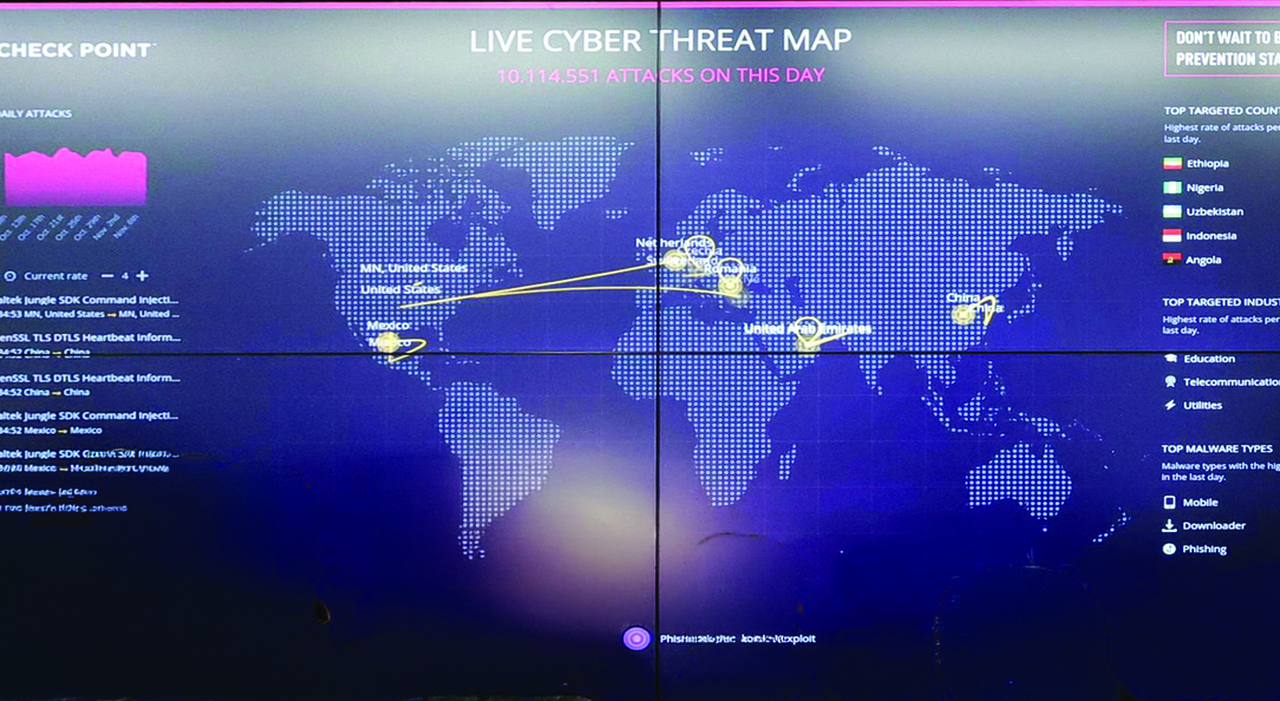
Italy is assembling a dedicated structure to counter hybrid warfare, including a planned core of 1,200 military cyber specialists, as Foreign Minister Antonio Tajani said the country is facing a sustained campaign of attacks rather than isolated incidents. According to Il Messaggero, Tajani spoke at the Farnesina's cyber room, a facility he commissioned that has been running around the clock for a year, where a large screen displays figures on attacks against Italian systems.
The minister, who has himself been targeted along with his family, said the evidence points eastward while cautioning that responsibility still needs to be established. He drew a distinction between pro-Russian hackers acting on their own and the possibility of direction from a foreign state, saying that if precise responsibilities were confirmed, Italy would respond through diplomatic and political channels. "We will certainly not be intimidated," he said, according to Il Messaggero.
Why it matters
The figures cited at the facility illustrate the scale of the problem. Il Messaggero reports that 630,000 attacks were blocked over the past year and that 3.5 million malicious emails were directed at the foreign ministry alone. Tajani argued that such volumes mean Italy can no longer treat the activity as a series of separate episodes, describing instead a strategy aimed at destabilising the country, sowing chaos and spreading fear. He called for a political response alongside a technological one, and for closer cooperation among allies.
The issue is also personal for the minister. Tajani discovered that a bounty had been placed on him and his relatives, with sensitive information offered in exchange for cryptocurrency payments, Il Messaggero reports. The same case reportedly involved Rome's chief prosecutor Francesco Lo Voi, the head of the postal police Ivano Gabrielli and the mayor of Aviano, Paolo Tassan-Zanin. The mayor told Corriere della Sera that he believes his town's American base explains why he was targeted, and that he is now more careful.
G7 pressure and a security meeting at the Viminale
Tajani has asked the G7 to coordinate against hackers and wants the group's foreign ministers, meeting in Paris, to send a strong signal on hybrid warfare. According to ANSA, he has argued that hybrid attacks strike at democracy itself. RaiNews reports that he called for G7 coordination against hacker activity. He has also promoted the new structure publicly, describing it on social media as "Argo," a guardian against hackers, according to Tgcom24.
At home, Interior Minister Matteo Piantedosi has summoned the national committee for public order and security to the Viminale. Il Messaggero reports that the meeting is meant to review information systems that remain vulnerable, identify new protocols for infrastructure needing stronger protection, and assess investigative leads on the recent cyber attacks. Investigators are also looking at whether some threatening messages sent to Italian airports originated from compromised school email accounts; if confirmed, the government would consider raising cyber defences across schools. Other messages, the paper notes, were simply anonymised through the Proton Mail service. The review is intended to map every gap that let the attackers operate so easily and to screen infrastructure that remains too exposed.
A fast-track bill and a fight over who leads
One building block is a government bill moving through the Senate. Il Messaggero reports that it reached the foreign affairs and defence committee on 24 September and is being examined under a procedure designed to speed its passage to the floor, with a vote possible in the first weeks of December. Maurizio Gasparri, who chairs the committee and is the bill's rapporteur, said the measure is advancing as quickly as a decree.
The bill would establish a dedicated centre for countering hybrid warfare, starting with an initial group of personnel and scaling up to 1,200 cyber troops holding a specific certification — described as a kind of anti-piracy licence. The force would need dedicated funding, partly to attract the most capable people in the field, those able to mount a counter-response to hacker attacks. Under the plan, the chief of defence staff would be designated as the cyber authority. Il Messaggero notes that some observers expect changes to the text along the way, and others predict obstacles, with one critic quoted warning that it hands too much power to the defence ministry — an apparent message to Defence Minister Guido Crosetto.
What to watch: the Viminale committee's findings, the G7 ministers' meeting in Paris, and whether the Senate keeps to the December timetable for the cyber bill.